
Bigodi Wetland Sanctuary: Ultimate Birding & Primate Walk
A visit to Bigodi Wetland Sanctuary offers one of the most concentrated and rewarding nature walks in Uganda. Located just outside Kibale National Park, this community-managed swamp is where serious birders tick off endemics and casual travelers fall in love with the noise, color, and chaos of a tropical wetland.
The Bigodi Wetland Sanctuary protects a narrow papyrus-fringed corridor that acts as a lifeline for over 200 bird species, eight primate species, and a community that has chosen conservation over short-term gain. If you want slow travel that delivers real density of sightings, this walk belongs on your Uganda safari itinerary.
Table of Contents
- What Exactly Is Bigodi Wetland Sanctuary?
- Bigodi Wetland Sanctuary Location and How to Get There
- Why the Bigodi Swamp Walk Punches Above Its Weight
- Birding in Bigodi: Species You Cannot Miss
- Primates and Other Wetland Wildlife
- The Community Behind the Sanctuary
- What the Bigodi Nature Walk Feels Like Minute by Minute
- Best Time to Visit Bigodi Wetland Sanctuary
- Bigodi Wetland Sanctuary Entrance Fees and Costs
- Expert Tips for Photographers and Birders
- Common Mistakes Travelers Make
- Responsible Tourism: Rules That Matter
- What to Pack for the Bigodi Swamp Walk
- Combining Bigodi With Chimpanzee Trekking in Kibale
- Frequently Asked Questions
- Conclusion and How to Book With Berengei Africa Safaris
What Exactly Is Bigodi Wetland Sanctuary?
Bigodi Wetland Sanctuary is a 4-square-kilometer community-owned wetland and forest corridor running along the eastern edge of Kibale National Park. It was established in 1992 by the Kibale Association for Rural and Environmental Development (KAFRED) to protect the Magombe Swamp, a biodiverse papyrus wetland that was rapidly being drained for agriculture. Unlike a government-run park, the land belongs to the surrounding families who receive direct income from every visitor who walks the trails.
The sanctuary’s existence is a deliberate choice. Before KAFRED formed, farmers saw the swamp as unproductive land. Now it generates revenue through guided walks, birding tours, craft sales, and a community lodge. The Bigodi Wetland Sanctuary protects habitat that would otherwise be gone and creates a buffer zone that benefits Kibale’s wildlife chimpanzees, colobus monkeys, and hornbills all move freely between the park and the swamp.
For travelers planning a broader Uganda safari, the sanctuary sits perfectly within the western safari circuit. Many of our guests at Berengei Africa Safaris combine it seamlessly with gorilla trekking in Bwindi Impenetrable National Park and classic game drives in Queen Elizabeth National Park. Our detailed Uganda adventure safaris guide maps out exactly how these destinations connect.
Bigodi Wetland Sanctuary Location and How to Get There
Bigodi sits in western Uganda, roughly 35 kilometers southeast of Fort Portal and directly adjacent to Kibale National Park’s Kanyanchu Visitor Center—the starting point for chimpanzee trekking. Most travelers arrive by road.
Distances by road:
| From Fort Portal: | 45 minutes |
| From Kampala/Entebbe: | 5 to 6 hours via Mubende–Fort Portal road |
| From Queen Elizabeth National Park: | 1.5 hours |
| From Bwindi (Buhoma): | 4 to 5 hours |
The sanctuary entrance sits right in Bigodi trading center. You park near the community visitor office, register, and meet your guide. No long transfers, no checkpoint hassles—just pull up and start walking. If you are already staying near Kibale for chimpanzee trekking, the swamp is a 5-minute drive from most lodges.
Bigodi works perfectly as a stop on longer itineraries. For example, our 7-day ultimate Uganda primate and wildlife safari builds in the swamp walk right after chimpanzee trekking, giving you a full day of primate encounters.
Why the Bigodi Swamp Walk Punches Above Its Weight
Travelers sometimes treat Bigodi as a filler activity between chimp trekking and the next long drive. That is a mistake. The Bigodi swamp walk routinely delivers more species per hour than a full-day game drive in many savannah parks. Here is why:
Boardwalks Get You Close
Walk through the heart of the wetland on raised boardwalks and firm earth paths. No vehicle noise, no dust, no restricted viewpoints. Birds and monkeys often sit within 10 meters.
Dense Edge Habitat
The transition zone between papyrus swamp, woodland, and farmland creates an edge effect that concentrates wildlife from three different habitats.
Knowledgeable Local Guides
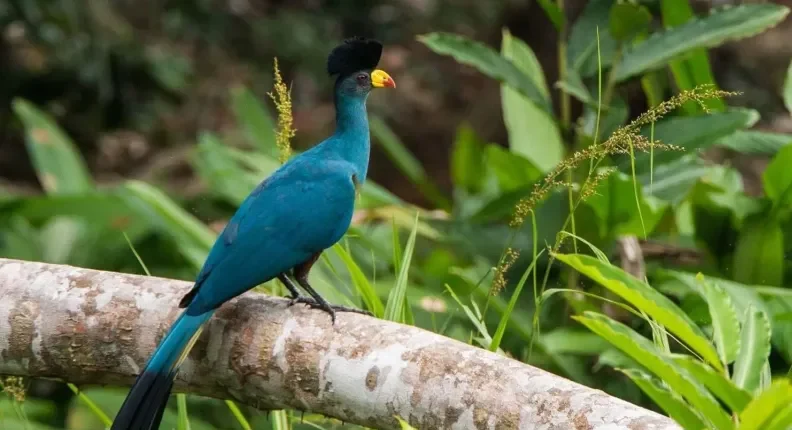
Bigodi’s guides grew up on the swamp’s edges. They know individual fig trees where Great Blue Turacos feed and exactly which hollow holds a nesting pair of Crowned Hornbills.
Low Walking Difficulty
Mostly flat trail with boardwalks covering wet sections. A gentle 3-hour loop suits anyone who can manage an easy woodland stroll.
If you enjoy walking safaris, you might also appreciate that Kibale National Park chimpanzee trekking pairs naturally with Bigodi. The same dense forest ecosystem that shelters chimpanzees feeds directly into the wetland corridor.
Birding in Bigodi: Species You Cannot Miss
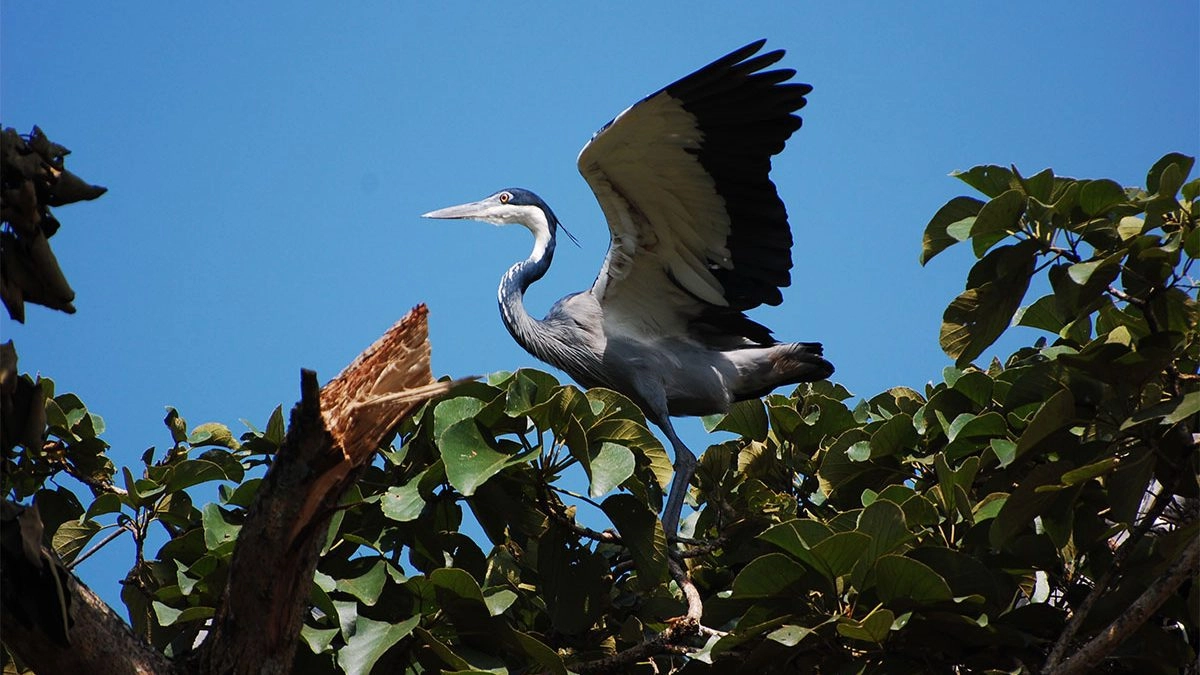
The Bigodi Wetland Sanctuary is widely considered one of the best birding sites in Uganda. The mix of papyrus specialists, forest edge birds, and woodland species in a single morning is rare even by East African standards.
Headline species birders target:
- Great Blue Turaco: Big, blue, and impossibly beautiful. Bigodi offers some of the most reliable sightings in Uganda.
- Papyrus Gonolek: A true papyrus endemic. Loud, striking, and often seen duetting in pairs right from the boardwalk.
- White-spotted Flufftail: Secretive, skulking, but frequently heard and occasionally seen along the drainage channels.
- Shining Blue Kingfisher: Tiny, electric-blue, and often perches low over water.
- Black-and-white-casqued Hornbill: Audible long before you see it, with a massive casque and creaking flight.
- Yellow-billed Barbet, Grey-winged Robin-Chat, Bocage’s Bushshrike, and African Pitta (seasonal).
Total bird species recorded: Over 200, with excellent chances of 40 to 60 species on a single morning walk.
For dedicated birders, Bigodi complements other prime sites across Uganda. Our birding in Uganda guide covers additional hotspots like Mabamba Swamp and Queen Elizabeth National Park.
Seasonal Birding Notes
Primates and Other Wetland Wildlife
Birds grab the headlines, but Bigodi Wetland Sanctuary is also a reliable primate site. The swamp and adjacent woodland host eight diurnal primate species.
Red colobus
Grey-cheeked mangabey
Red-tailed monkey
Vervet monkey
Olive baboon
Chimpanzees (occasional)
L’Hoest’s monkey
To learn more about some of these species, read our guide to the white colobus monkey and its role in Uganda’s forests.
Other Wildlife:
Sitatunga: The swamp-dwelling antelope with splayed hooves. Rarely seen on most safaris, but Bigodi’s boardwalk viewings are among Uganda’s best. Also bushbuck, banded mongoose, bush pig, and staggering butterfly diversity with dozens of swallowtail, charaxes, and pierid species.
The Community Behind the Sanctuary
Bigodi’s origin story matters. In the early 1990s, a local teacher and a Peace Corps volunteer noticed that the swamp was being cleared rapidly for rice and brick-making. They convinced families that tourism could pay more than draining the land. KAFRED formed in 1992, built trails, trained guides, and opened the sanctuary.
What your visit pays for directly:
- Guide salaries and training programs
- Secondary school scholarships for local students
- Community infrastructure (roads, water tanks, school construction)
- A women’s craft group that sells woven baskets, beads, and art near the entrance
When you walk the Bigodi swamp walk, your fee does not disappear into government coffers. It pays the guide walking beside you, funds the scholarship of a student you pass on the trail, and gives a farmer a reason to protect the wetland rather than drain it. That direct link between tourist spend and conservation outcome is still rare at scale, and Bigodi does it honestly.
This model of community-led conservation runs through many of the experiences we recommend. Our eco-friendly safaris in Uganda page explains how your travel choices support local livelihoods.
What the Bigodi Nature Walk Feels Like Minute by Minute
0 to 15 minutes: You register at the visitor center, meet your guide, and receive a brief orientation. Walking sticks are available—take one. You enter the trail through mixed farmland and woodland. Red colobus monkeys often appear in the first five minutes.
15 to 45 minutes: You reach the boardwalk section that cuts directly into the papyrus. The soundscape changes immediately. Gonoleks call. Flufftails whine softly. Your guide stops frequently to point out weavers, coucals, and raptors overhead. This is the richest birding stretch.
45 minutes to 1.5 hours: The trail loops into denser woodland and swamp edge. This is where Great Blue Turacos, hornbills, and mangabeys are most likely. The guide checks specific trees, listens for alarm calls, and occasionally whistles to elicit responses from birds.
1.5 to 2.5 hours: You loop back through a different section of papyrus. Sitatunga sightings peak in late afternoon. The light turns golden. By the time you exit near the trading center, you have walked roughly 4 to 5 kilometers at a very easy pace.
Best Time to Visit Bigodi Wetland Sanctuary
Best time of day: The sanctuary is open from 7:30 AM to 5:00 PM. The best walks start at 8:00 AM (peak bird vocal activity) or 3:30 PM (soft light, sitatunga emerging). Midday is quieter for birds but still decent for primates.
For broader seasonal planning across Uganda, consult our best time to visit Uganda guide. The western region around Kibale and Bigodi follows similar patterns to the rest of the country.
Bigodi Wetland Sanctuary Entrance Fees and Costs
Additional costs (optional):
- Guide tip: $5 to $10 per person (appreciated)
- Community village walk: ~$10
- Women’s craft group: free to browse
- Traditional lunch with local family: $5 to $10
Compared to a chimp trekking permit ($250) or gorilla permit ($800), Bigodi delivers extraordinary value per wildlife sighting. For a full breakdown of permit costs across Uganda, see our safari permits and fees page.
Expert Tips for Photographers and Birders
- 400mm minimum lens for small passerines and distant turacos. A 100–400mm zoom handles most situations well.
- Spot-meter on the bird, not the bright background. Papyrus edges and deep shade create high contrast.
- Monopod over tripod — boardwalks and narrow trails make tripods cumbersome.
- Don’t forget macro lens for Bigodi’s stunning butterflies and dragonflies.
- Ask guide to pause before pointing so you can find the bird in your viewfinder.
If photography is a priority on your trip, you might enjoy our jungle safaris to try article, which covers some of Uganda’s most photogenic forest experiences.
Common Mistakes Travelers Make
- Skipping Bigodi because they’re tired after chimp trekking. The swamp walk is low-effort and often becomes the unexpected highlight of the day.
- Walking too fast — people who rush through in 90 minutes see half of what a slow 3-hour walk reveals.
- Not bringing binoculars — many prize species stay back in the canopy.
- Ignoring the guide’s suggestions — they know where individual bird pairs nest.
- Not carrying cash — the craft group and community lunch are cash-only.
Responsible Tourism: Rules That Matter
- Stay on the designated trails and boardwalks. Off-trail walking damages fragile wetland vegetation and disturbs nesting birds.
- Do not feed wildlife. Baboons already raid nearby crops. Feeding them worsens human-wildlife conflict.
- Keep voices low. Loud conversation flushes birds and stresses mammals.
- Ask permission before photographing people. The craft group members and guides are friendly, but consent matters.
- Pack out all trash. There are no bins on the trail.
- Tipping is not mandatory but is appreciated. Guides rely on tips to supplement their income.
These principles align with the advice in our how to prepare for a safari guide, which covers responsible travel practices in detail.
What to Pack for the Bigodi Swamp Walk
Long trousers
Rain jacket
Binoculars (8×42)
Camera (300mm+)
Water (1 liter)
Insect repellent
Cash for tips/crafts
For a comprehensive gear list, read our what you need to know before safari page.
Combining Bigodi With Chimpanzee Trekking in Kibale
Most travelers visit Bigodi Wetland Sanctuary on the same day as chimpanzee trekking in Kibale National Park. That works perfectly logistically.
Sample one-day itinerary:
| 6:30 AM | Breakfast at your lodge near Kibale |
| 7:00 AM | Arrive at Kanyanchu Visitor Center for chimp trekking briefing |
| 8:00 AM to 12:00 PM | Chimp trekking and forest walk |
| 12:00 to 1:00 PM | Lunch |
| 2:00 to 5:00 PM | Bigodi swamp walk |
| Evening | Community dinner or return to lodge |
Explore our full chimpanzee trekking Kibale guide for permit details and trekking tips. For a longer adventure that includes both Kibale and Bwindi, consider our 7-day gorilla trekking golden monkey Queen safari.
The crater lakes region near Fort Portal also makes an excellent addition. Read about the crater lakes of Fort Portal for scenic stops between Kibale and Bigodi.
Frequently Asked Questions
1. How long does the Bigodi swamp walk take?
Most guided walks last 2.5 to 3 hours, covering approximately 4 to 5 kilometers on flat boardwalks and earth trails. Birders often take longer up to 4 hours because of frequent stops.
2. Do I need to book Bigodi Wetland Sanctuary in advance?
Advance booking is not required. You can arrive and pay at the visitor center. However, if you want a specialist birding guide, contact KAFRED or have Berengei Africa Safaris request one a day ahead.
3. Is the Bigodi nature walk suitable for children?
Yes. The trail is flat, safe, and short enough for children aged six and above. Strollers are not practical on the dirt sections.
4. Can I visit Bigodi without doing chimpanzee trekking?
Absolutely. The sanctuary operates independently of Kibale National Park. Many birders visit Bigodi specifically for the wetland birding and never enter the forest park.
5. Are there any dangerous animals in Bigodi Wetland Sanctuary?
Large predators are absent. Occasional elephants have moved through the corridor from Kibale, but this is rare. Snakes exist but are seldom seen on the raised boardwalks. Your guide manages any risks.
6. What is the difference between Bigodi and Mabamba Swamp?
Mabamba Swamp, near Entebbe, is famous for Shoebill sightings. Bigodi does not have Shoebill but offers far greater overall bird diversity, primates, sitatunga, and a richer community tourism experience. Read our Mabamba Swamp birdwatching Uganda guide for a full comparison.
7. Is Bigodi Wetland Sanctuary wheelchair accessible?
The initial section of boardwalk can be navigated with assistance, but the full loop includes uneven earth paths and steps. Wheelchair users can access the first 300 meters of boardwalk with good birding views. Contact KAFRED ahead to discuss specific needs.
8. Are toilet facilities available at Bigodi Wetland Sanctuary?
Yes. Basic, clean pit latrines are available at the visitor center near the trailhead. There are no facilities once you are on the trail, so use them before starting.
9. Does rain cancel the walk?
No. The walk operates in rain. Boardwalks keep you above flooded ground. Bring a rain jacket and a waterproof bag for your camera. Bird activity often increases during light rain.
10. Can I hire binoculars at Bigodi Wetland Sanctuary?
Binocular rentals are not currently available on site. You must bring your own. Some safari lodges near Kibale offer loaner binoculars—check with your accommodation.
11. What birds can I see at Bigodi Wetland Sanctuary?
The wetland hosts over 200 species. Key targets include Great Blue Turaco, Papyrus Gonolek, White-spotted Flufftail, Shining Blue Kingfisher, Black-and-white-casqued Hornbill, and Grey-winged Robin-Chat. Dedicated birders often log 50+ species on a single morning walk.
12. How much is a guided walk in Bigodi?
The standard foreign non-resident fee is $15 per person, which includes the community guide. Specialist birding guides are available at the same rate upon request. Tips are additional and appreciated.
A Morning Walk That Stays With You
Bigodi Wetland Sanctuary does not demand a huge investment of time, money, or physical effort. It simply asks you to walk slowly, listen carefully, and pay attention to the life packed into a small patch of papyrus. In return, it offers bird sightings that rival any protected area in East Africa, primates moving freely between forest and swamp, and the quiet satisfaction of supporting a community that bet its future on conservation—and won.
Ready to Add Bigodi to Your Uganda Safari?
At Berengei Africa Safaris, we include the Bigodi swamp walk in most Kibale itineraries because we have seen it consistently delight travelers who had no idea what to expect. Our guides know the best local birding specialists, the right time of day to time your visit, and how to combine the sanctuary seamlessly with chimpanzee trekking and the rest of western Uganda’s highlights.
Browse our Uganda safari packages or view all our tours to find an itinerary that includes Bigodi. If you need something tailored, contact us directly. Tell us what you love birds, primates, photography, community stories, or all of it and we will build an itinerary that fits your pace and budget. Read more about our story and why travelers trust us with their East African adventures.